Shefware Logo
Home
Office 365 MigrationImport PST to Office 365Exchange Online MigrationOneDrive MigrationEmail MigratorIMAP to Office 365
View All Products →

Services

Google Workspace to Microsoft 365 MigrationEmail ConversionOffice 365 MigrationTenant to Tenant MigrationCloud BackupTeams Migration

Solutions

Office 365 MigrationEmail MigrationOffice 365 BackupIMAP BackupIMAP to Office 365SharePoint BackupEmail ConversionOST to PST ConverterPST SplitPST Password Recovery
More Products →

Platform

Microsoft 365Amazon Web Services (AWS)Microsoft AzureMicrosoft OutlookMicrosoft Exchange ServerGoogle WorkspaceSharePointHCL Notes
Marketplace
About UsCareersReviewsSupport
Contact Us
ShefwareSmarter Technology

1316 Wall Street, Everett, WA 98201, USA

support@shefware.com
+1 888 425 1161

About

  • About Us
  • Careers
  • Privacy Policy
  • Refund Policy
  • Terms to Use
  • EULA

Solutions

  • Cloud Migration
  • Email Migration
  • Cloud Backup
  • Data Recovery
  • File Conversion
  • Free Tools

Partner

  • Affiliates
  • Resellers
  • Distributors

Resources

  • Blog
  • Knowledge Base
  • Case Studies
  • How To
  • FAQs
  • Downloads
DMCA Protected© 2026 Shefware. All rights reserved.
Email Migration

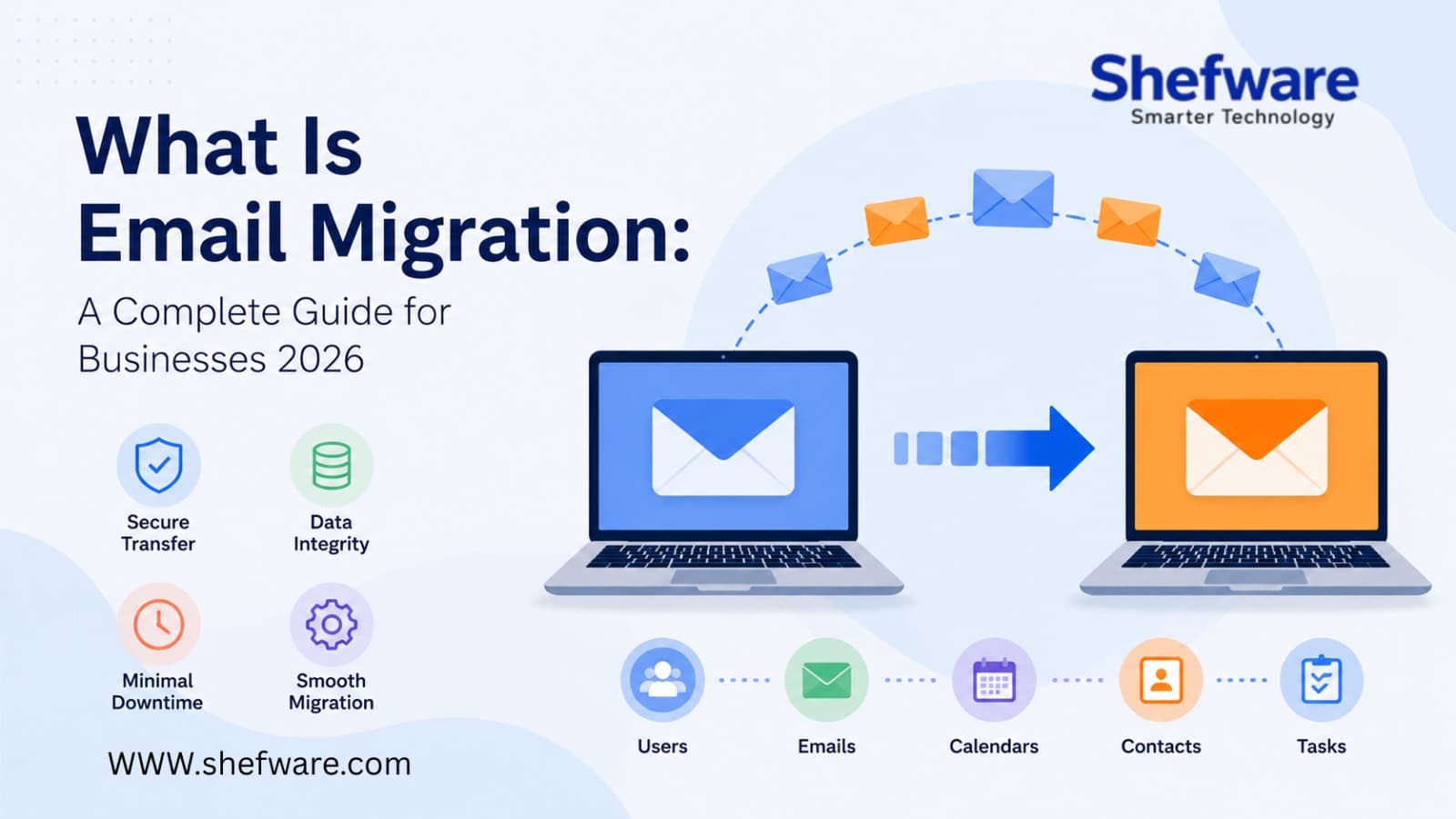
What Is Email Migration: A Complete Guide for Businesses 2026

E

Written By

Elan Clain
M

Approved By

Mr. Tarun Kumar

Published on

14 Jul 2026

Min Reading

8 Min
email migration, email migration tool, email migration services , email migration service, email migration software, google workspace email migration, office 365 email migration, email migration checklist, email migration project plan template, microsoft email migration, email migration plan, 365 email migration

What Is Email Migration: A Complete Guide for Businesses 2026

Email is the backbone of business communication, making a dependable email platform important for productivity and collaboration. As companies or organizations grow, they select to change providers, advance to cloud-based services, or combine various email systems. A complete migration contains not only moving messages, but more than that. While small migrations can often be completed manually, many businesses depend on email migration tool or email migration services to simplify the process.

What is Email Migration?

Email Migration is the process of moving email data from one server to another. Businesses sometimes move to enhance collaboration, security, storage capacity, and modernize their IT infrastructure. It depends on the company's needs, but a migration might contain:

  1. 1.Email and Attachments
  2. 2.Calendars
  3. 3.Contacts
  4. 4.Tasks and Notes
  5. 5.Folder Sequence
  6. 6.Shared mailboxes
  7. 7.Email Metadata

Utilizing email migration software makes sure that the details are moved accurately while saving the original mailbox structure.

Why Do Businesses Require Email Migration?

The organizations move their email systems for various reasons. Many are advancing to cloud-based platforms; on the other hand, replace old infrastructure or merging various business environments. Some of the most common reasons include:

  • Migrating to Microsoft 365 or Google Workspace
  • Combining various email domains
  • Enhancing the security of email
  • Increase mailbox storage
  • Assist with online and hybrid work
  • Meeting compliance needs
  • Limiting IT maintenance costs
  • Enhancing collaboration on various teams

As the business grows, manual migration becomes complex. The Email migration services and automatic tools help companies complete migrations quickly while limiting business disruptions.

Why Choose an Email Migration Tool?

The manual migrations need important planning and can become difficult when various mailboxes are involved. An automatic email migration tool provides various benefits:

  • Quick mailbox migration
  • Limited downtime
  • Safe authentication
  • Protection of folder sequence
  • Assistance for bulk mailbox migration
  • Minimum effort manually

For businesses looking for a solution, Shefware Email Migrator assists in safe migrations on various email platforms with a user–friendly interface developed for both IT experts and business users.

Types of Email Migration

Selecting the correct migration approach relies on the existing email environment and the destination platform. Let’s understand each type of migration for your better understanding:

Office 365 Migration

The Office 365 Migration is the common migration project nowadays. Businesses migrate to Microsoft 365 to get the benefit from enhances collaboration, storage, upgraded security, and centralized administration. Relying on the company's size, administrators might select cutover, staged, or hybrid approaches.

Google Workspace Email Migration

Some organizations run Google Workspace email migration when changing from old email systems or changing between business productivity platforms. A proper migration makes sure emails, contacts, and calendars are moved precisely.

Microsoft Email Migration

The Microsoft Email migration involves migrating mailboxes between Exchange environments, Microsoft 365 tenants, or other related platforms while managing mailbox integrity and user access.

What kind of data can be migrated?

An overall migration email migration contains more than email messages. Modern email migration software can migrate a wide range of mailbox data, including emails, Attachments, Contacts, Calendars, Tasks, Notes, Shared mailboxes, folder structure, and email metadata. Moving all important data ensures users can continue working without losing crucial business details.

Email Migration Plan

Every migration begins with a transparent email migration plan. Structured planning minimizes risks, prevents sudden problems, and keeps the project on schedule.

Step 1: Assess Current Email Environment

Review the mailboxes, storage needs, user accounts, and email platforms. Find inactive accounts and unimportant data before the migration starts.

Step 2: Choose the Destination Platform

Select the platform that fits business needs, whether it's Microsoft 365, Google Workspace, Exchange Online, or another cloud-related solution.

Step 3: Generate an Email Migration Project Plan

Design an Email migration project plan template that clarifies goals, timelines, responsibilities, procedures, and rollback methods if a problem arises.

Step 4: Back Up Existing Mailboxes

Always generate a full backup before beginning the migration process. A backup offers an extra layer of protection against errors.

Step 5: Run a Pilot Migration

Validate the migration with a small number of users. This permits administrators to find problems and check the migration process before transferring all mailboxes.

Step 6: Migrate Business Mailboxes

When the validation process is completed, move the rest of the users. With the help of Shefware Email Migrator helps automate this phase by assisting in safe, large-scale mailbox migration while protecting it.

Step 7: Verify Migrated Data

After the migration, you need to confirm that all the data has been transferred completely.

Email Migration Checklist

Before initiating your migration project, use the migration checklist mentioned below:

  • Check all user mailboxes.
  • Delete inactive or duplicate accounts.
  • Back up email data.
  • Verify user licenses.
  • Allocate the destination environment.
  • Validate the migration with a pilot group.
  • Notify users regarding the migration schedule.
  • Use an email migrator like Shefware Email Migrator.
  • Test migrated mailbox data.
  • Check system performance after the migration process.

Following a structured checklist helps reduce migration risks and ensures a smoother transition for your organization.

Conclusion

A complete migration needs proper planning, the correct approach, and a dependable solution to make sure your business continues. If you are running Office 365 email migration, Google Workspace email migration, or moving between other email platforms, following an organized plan and checklist can help in limiting downtime and saving your data. Using the right tool, like Shefware Email Migrator, with its advanced features and reliable security, helps in running the migration process easily.

Related posts

Email Migration

How to convert an OST File to PST using the Shefware OST to PST Converter?

→

Email Migration

Cloud Email Migration: Best Practices for Enterprise

→

Frequently asked questions

Ans. Email Migration is the procedure of migrating emails, attachments, contacts, calendar, and other mailbox data from one server to another.

Ans. The migration tool limits manual effort, decreases downtime, and protects mailbox data, folder sequence, and email metadata.

Ans. Email migration software can migrate a wide range of mailbox data, including emails, Attachments, Contacts, Calendars, Tasks, Notes, Shared mailboxes, folder structure, and email metadata.